Segment
Routing.
Beyond the Syntax: Source Routing & The End of State.
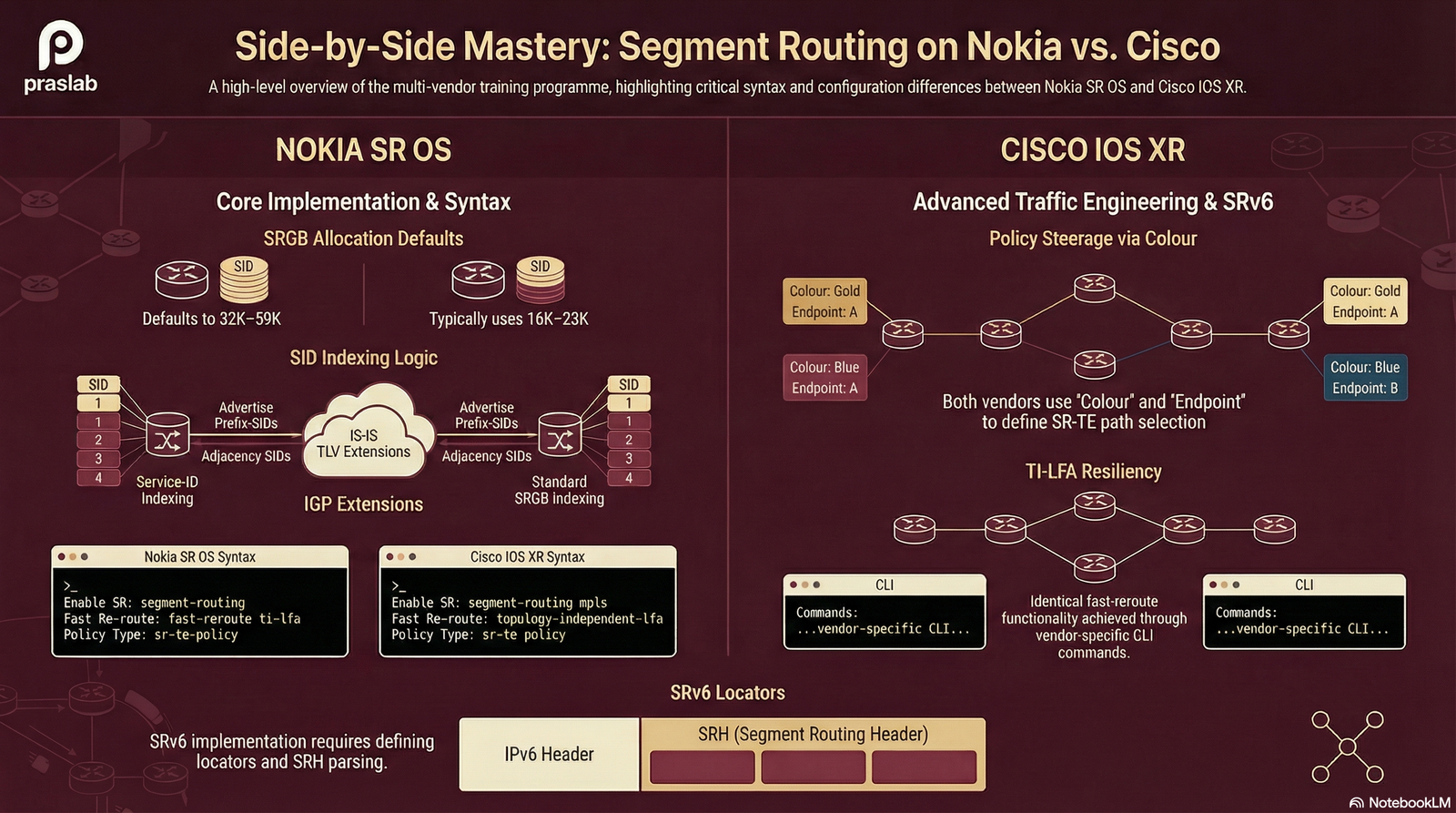
Integrated Video: SR Architecture
Short Answer Quiz
- What are the default Segment Routing Global Block (SRGB) ranges for Nokia SR OS and Cisco IOS XR?
- How does the configuration syntax for enabling Segment Routing within IS-IS differ between the two vendors?
- Explain the primary purpose of Topology-Independent Loop-Free Alternate (TI-LFA) in an SR environment.
- What specific CLI commands are used to verify Segment Routing Traffic Engineering (SR-TE) policies on both platforms?
- What is the functional difference between how Nokia and Cisco handle Segment Identifier (SID) indexing?
- How is an SRv6 locator defined on a Cisco IOS XR platform?
- Identify the symptoms and the fix for an SRGB Mismatch issue in a multi-vendor network.
- What role do IGP extensions, such as IS-IS TLVs, play in Segment Routing?
- What are the key components required to configure an SR-TE policy on a Nokia SR OS device?
- Describe the troubleshooting steps to take when Segment Identifiers (SIDs) are not being learned across the network.
Answer Key
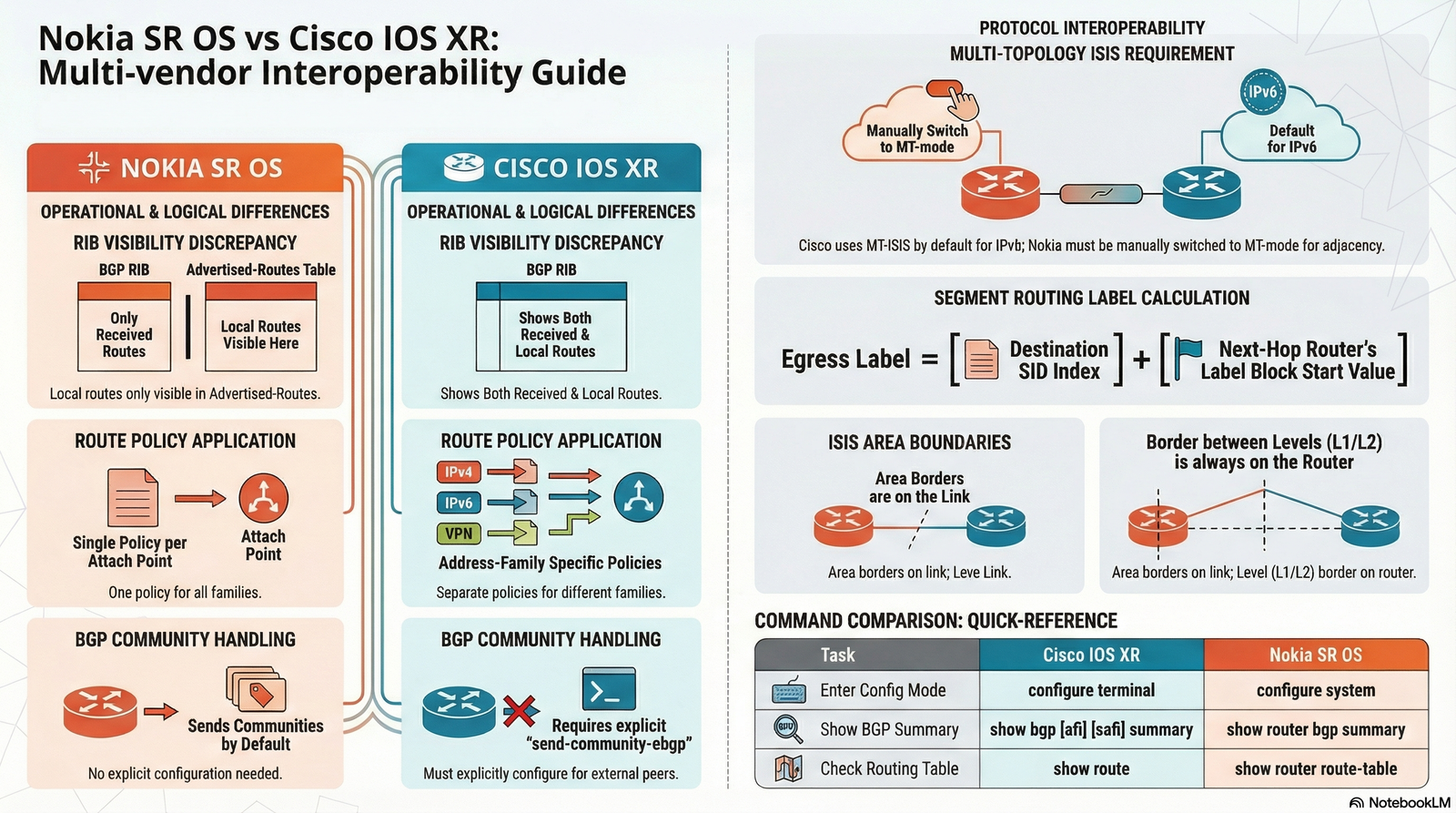
1. Nokia vs. Cisco SRGB Ranges: Nokia SR OS utilizes a default SRGB range of 32,000 to 59,000. In contrast, Cisco IOS XR typically defaults to a range of 16,000 to 23,000.
2. Configuration Syntax: Nokia enables SR under the IGP instance, whereas
Cisco requires an explicit segment-routing configuration block.
3. TI-LFA Purpose: TI-LFA provides a guaranteed loop-free backup path for any topology, protecting against link, node, and SRLG failures, and ensures sub-50ms traffic restoration.
4. SR-TE Verification: Nokia uses show router mpls sr-te policy
while Cisco uses show segment-routing traffic-eng policy detail.
5. SID Indexing: Nokia specifically utilizes a service-id for its indexing logic within the SR-MPLS framework. Cisco identifies these ranges and indices primarily through the Segment Routing Global Block (SRGB) indexing system.
6. SRv6 Locator: To define an SRv6 locator on Cisco, the administrator must
enter the segment-routing srv6 mode, specify a locator name, and then assign a
specific IPv6 prefix using the address ipv6 command.
7. SRGB Mismatch: This issue is identified by checking the prefix-SIDs or global blocks on both routers; symptoms include label inconsistencies. The fix requires aligning the SRGB ranges across all participating nodes.
8. IGP Extensions (IS-IS TLVs): IS-IS TLVs are essential for distributing SR-related information, such as Prefix-SIDs and Adjacency-SIDs, throughout the network.
9. SR-TE Policy Components: Requires a defined path (explicit or dynamic), a binding-sid, and a color value to identify the traffic class.
10. Troubleshooting SIDs: If SIDs are missing, verify IGP flooding, check SRGB configuration, and ensure the prefix-sid is configured under the loopback interface.
Essay Questions
- Comparative Architectural Analysis: Compare and contrast the implementation of SR-MPLS on Nokia SR OS versus Cisco IOS XR, focusing on SRGB allocation, SID advertisement, and the specific CLI hierarchies used by each vendor.
- SRv6 vs SR-MPLS: Detail the configuration requirements for SRv6 as outlined in the source. What are the conceptual differences between SR-MPLS and SRv6 regarding locators and Segment Routing Headers (SRH)?
- Multi-Vendor Interoperability: Based on the troubleshooting matrix provided, describe the potential hurdles when integrating Nokia and Cisco equipment in a single SR domain. Focus on SRGB consistency, TE policy handoffs, and inter-domain SR.
Glossary of Key Terms
Adj-SID
A segment identifier representing a specific local adjacency or link between two routers.
Color
A value used in SR-TE policies to steer traffic into specific paths based on business logic or service levels.
EPE (Egress Peer Engineering)
A traffic engineering method allowing a source AS to control the exit point of traffic towards a peer AS.
EVPN (Ethernet VPN)
A service type often deployed over an SR-MPLS or SRv6 fabric to provide Layer 2 and Layer 3 connectivity.
Flex-Algo
A feature that allows for the creation of multiple customized IGP topologies (algorithms) for different traffic requirements.
IS-IS TLV
Type-Length-Value encoded fields within the IS-IS protocol used to carry Segment Routing extensions.
PCE (Path Computation Element)
An entity or server that computes paths for SR-TE policies based on network constraints.
Prefix-SID
A segment identifier assigned to a specific IP prefix, typically representing a loopback address of a node.
SRGB (Segment Routing Global Block)
The range of labels reserved for global segments (like Prefix-SIDs) in an SR-MPLS network.
SRH (Segment Routing Header)
An IPv6 routing header extension used in SRv6 to carry a list of segments.
SR-TE (SR Traffic Engineering)
The use of Segment Routing to create specific paths through the network that deviate from the shortest path calculated by the IGP.
SRv6
Segment Routing implemented directly on the IPv6 data plane using IPv6 addresses as segments.
TI-LFA
Topology-Independent Loop-Free Alternate; a fast-reroute mechanism providing sub-50ms protection for any topology.