Life of a
Packet.
From the initial HTTP GET to the final ACK: A microscopic view of IP transit.
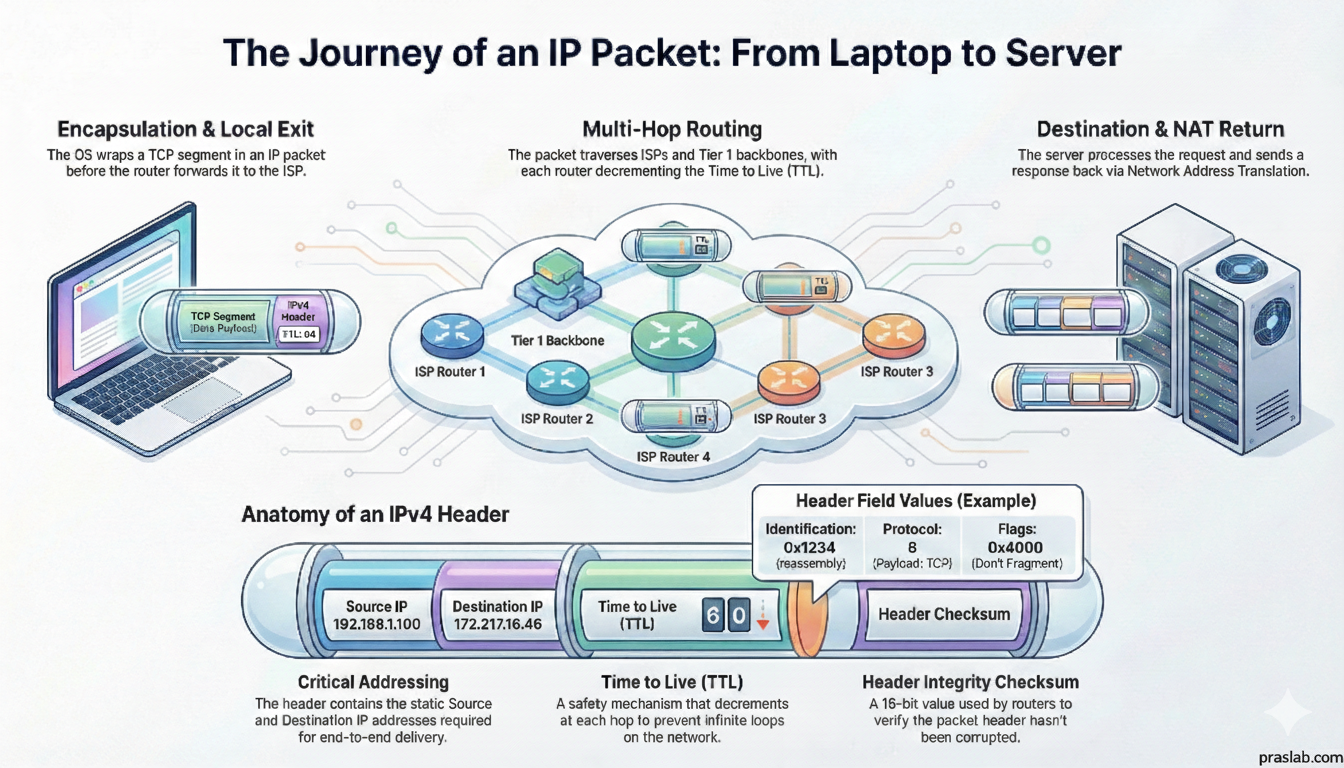
The Birth of a Segment
It starts with the application. When Alice requests https://example.com, her browser generates data. This
data is handed to the Transport Layer (Layer 4).
Here, the Segment is born. Source and destination ports are assigned. The data is sliced into portions small enough to fit the MTU of the local network—typically 1500 bytes.
Header Checklist: Transport
- [1] TCP/UDP Port Assignment
- [2] Sequence Number Calculation
- [3] MTU Check & Segmentation
- [4] Initial Handshake (if TCP)
Protocol Dissection: IPv4 Header
| Field | Functionality | Architectural Importance |
|---|---|---|
| Version | Identifies IPv4 protocol. | Ensures correct engine processing. |
| Total Length | Header + Payload size. | Defines processing buffer requirements. |
| Identification | Fragment tracking ID. | Critical for packet reassembly. |
| TTL (Time to Live) | Hop limit counter. | Eliminates infinite loops in SP networks. |
| Protocol | TCP (6), UDP (17), etc. | Defines the upper-layer payload handler. |
| Dest Address | Final target IPv4. | The primary key for RIB/FIB lookups. |
Enter the Router: L3 Processing
Ingress Check
Checksum verification and MTU check. Router confirms the packet is valid before committing CPU/ASIC cycles.
TTL & Cheksum
TTL decremented. Header Checksum recalculated. If TTL hits 0, the packet is "dropped on the floor".
FIB Lookup
Longest Prefix Match (LPM) in the FIB. The router finds the next hop and exit interface.
Integrated Video: Step-by-Step Visualization
The Paradox of the L2 Rewrite
While the L3 IP Address remains constant (End-to-End), the L2 Physical Address changes at **every single hop**.
The router strips the old Ethernet header and prepends a new one featuring its own exit MAC and the Next Hop's MAC. This is the rhythmic "hop-by-hop" propulsion that moves data across the planet.