BGP - Internet's
Secret Language.
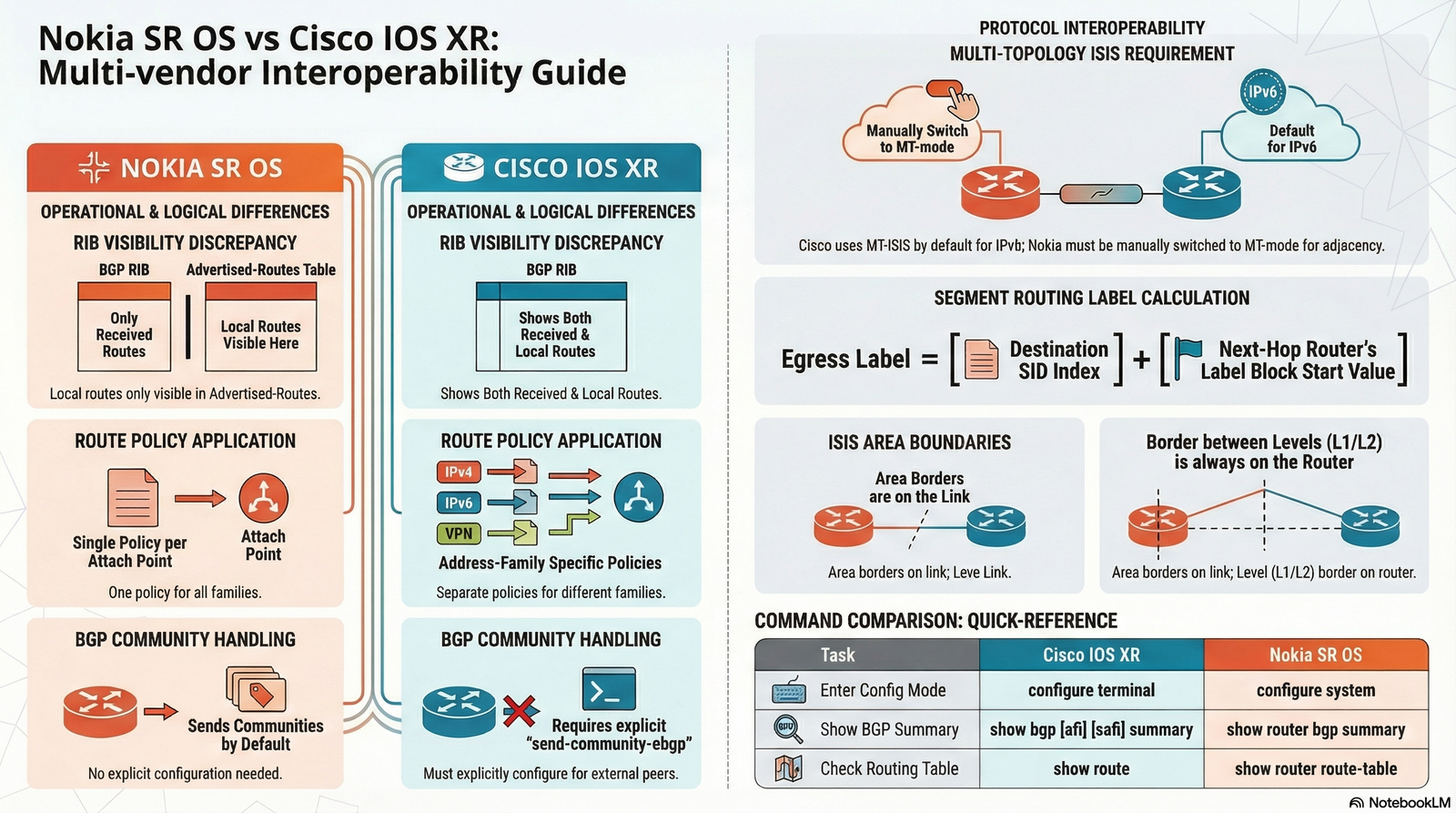
Multivendor Interoperability & The Ghosts in the RIB.
Integrated Video: BGP Demonstration
Short Answer Quiz
- How do Nokia SR OS and Cisco IOS XR differ in how they display locally originated routes in the BGP RIB?
- What is the "Weight" attribute in Cisco BGP, and how does it affect path selection?
- Explain the role of the "A-bit" (Attached bit) in an IS-IS LSP.
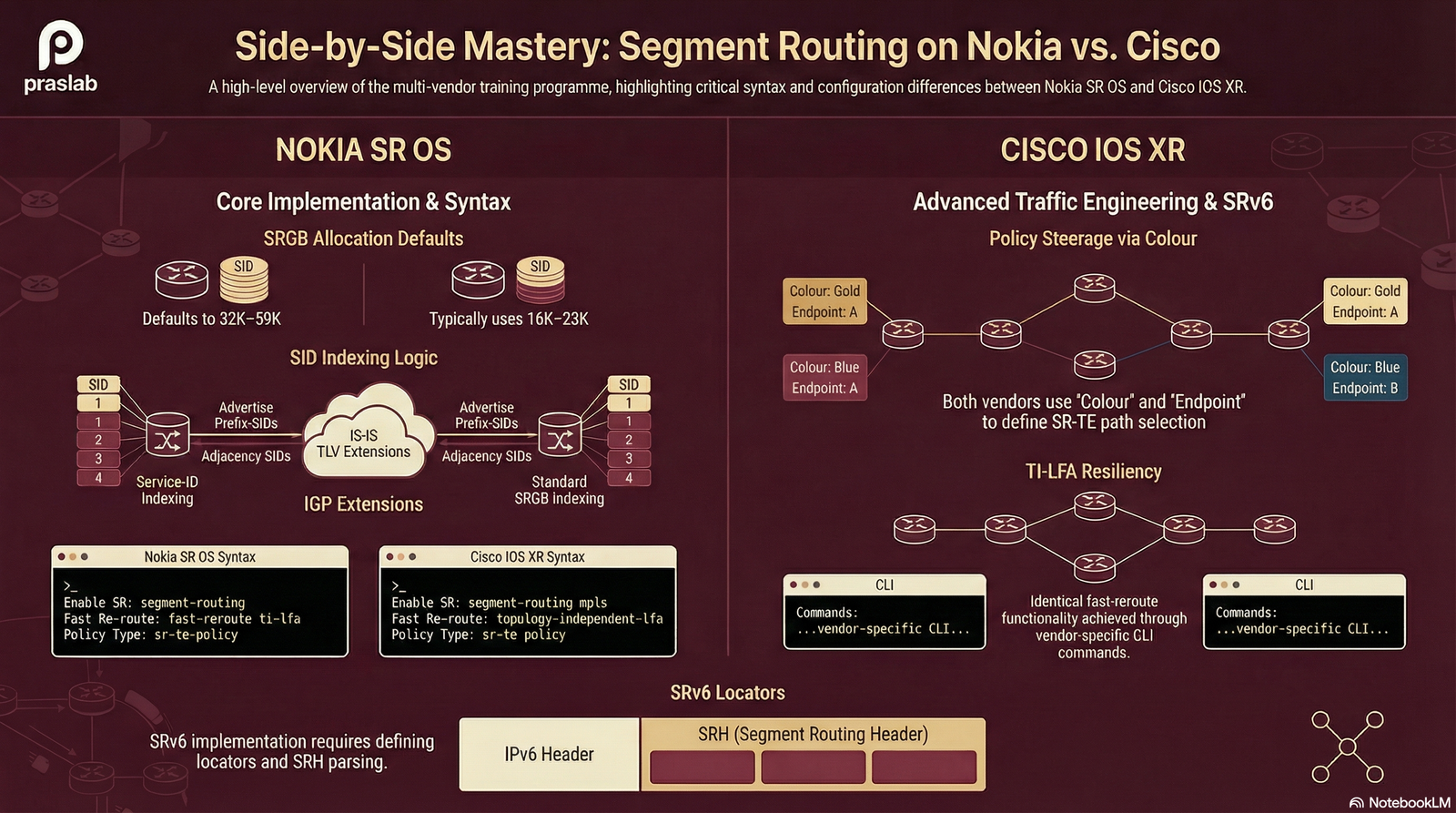
- What is the mathematical rule used by Segment Routing (SPRING) routers to calculate an egress label?
- What are the two primary options for adding IPv6 routing to an existing BGP environment?
- How does the application of route policies differ between Nokia SR OS and Cisco IOS XR regarding address families?
- What is the function of a Designated Intermediate System (DIS) in an IS-IS broadcast network?
- How does Segment Routing information get distributed within an OSPF area?
- What is "Route Leaking" in IS-IS, and why is it used?
- Describe the impact of the "summary-only" command during BGP prefix aggregation.
Answer Key
1. RIB Display Differences: Cisco IOS XR displays both received and locally originated routes in its BGP RIB. In contrast, Nokia SR OS typically only shows received routes in the Adj-RIB-In; local routes must be verified via the Adj-RIB-Out or advertised-routes commands for specific neighbors.
2. Cisco Weight Attribute: Weight is a Cisco-proprietary path attribute local to the router that is not advertised to peers. It is the highest priority factor in the Cisco path selection process, where the route with the highest numerical weight is preferred.
3. The Attached Bit: When an L1L2 router has neighbors in other areas (the backbone), it sets the "A-bit" in its Level-1 LSP. When a Level-1-only router sees this bit, it automatically installs a default route pointing toward that L1L2 router to reach inter-area destinations.
4. SPRING Label Calculation: The egress label is calculated as the sum of the destination node's index (SID) and the first label in the label block of the next-hop router. This allows routers to calculate labels independently without the need for traditional label signaling protocols like LDP.
5. IPv6 BGP Options: One option is to add the IPv6 unicast address family to an existing IPv4 peering session, which requires manual next-hop manipulation. The second option is to establish a completely independent BGP session between IPv6 addresses, which increases management overhead but keeps the families separated.
6. Policy Application: Nokia SR OS uses a single export or import policy per attach point (neighbor, group, or global) that covers all address families simultaneously. Cisco IOS XR decouples these, allowing specific route policies to be applied per neighbor, per group, and per specific address family.
7. DIS and Pseudonodes: In broadcast segments, the DIS is elected to generate a separate LSP representing a "pseudonode." This simplifies the link-state database by making all routers on that segment appear as if they have point-to-point connections to the pseudonode rather than each other.
8. OSPF Distribution of SR: Segment Routing information is distributed in OSPF using Type 10 Opaque LSAs, which have an area-wide scope. These LSAs contain TLVs that describe the router's SR capabilities, label ranges, and Prefix SIDs.
9. IS-IS Route Leaking: Route leaking is the process of propagating Level-2 routes into a Level-1 area. This is used to provide Level-1 routers with specific reachability information for inter-area prefixes, which they would otherwise only reach via a default route.
10. Summary-Only Impact: Using the "summary-only" keyword during BGP aggregation filters out the more specific component routes from being advertised, sending only the aggregate prefix. While this reduces the size of the routing table, it can cause traffic drops if internal routers require the more specific routes for proper forwarding.
Essay Questions
- Comparative Analysis of BGP Route Policies: Compare and contrast the architecture of route policies in Nokia SR OS and Cisco IOS XR. Discuss the implications of Nokia's inheritance-free, single-policy approach versus Cisco's decoupled, per-address-family approach.
- Hierarchical Routing in IS-IS: Discuss the organizational structure of IS-IS levels (L1, L2, L1L2) and areas. Explain how this structure facilitates scalability in large service provider networks and how it differs from the OSPF backbone/area model.
- The Mechanics of Segment Routing (SPRING): Explain how Segment Routing builds an MPLS forwarding plane without traditional signaling protocols. Detail the roles of the Global Label Block, Node-SIDs, and the independent label calculation rule used by multi-vendor nodes.
- Traffic Engineering via BGP Communities: Analyze the use of standard BGP communities as defined in RFC 1998. Describe how a customer can use these "tags" to influence the local preference and ingress traffic patterns of their Internet Service Provider.
- Multi-Vendor Interoperability Challenges: Based on the technical excerpts, identify at least three specific configuration or operational mismatches that can occur between Nokia and Cisco (e.g., MTU, Multi-topology IS-IS, or BGP RIB views) and explain how they are resolved.
Glossary of Key Terms
Adj-RIB-In
The BGP database containing unprocessed routing information received from peers.
Aggregate-Address
A BGP mechanism used to summarize multiple specific routes into a single, shorter prefix to reduce routing table size.
Autonomous System (AS)
A collection of IP networks under the control of one or more network operators that presents a common routing policy to the Internet.
BGP Community
A numerical tag added to BGP routes that allows for flexible route filtering and traffic engineering at receiving peers.
DIS (Designated Intermediate System)
A router elected in IS-IS broadcast networks to manage the adjacency and generate pseudonode LSPs.
LSP (Link State Packet)
The fundamental packet used in IS-IS to distribute adjacency and prefix information throughout the network.
Multi-Topology (MT)
An IS-IS mode that allows for independent topology calculations for different protocols, such as IPv4 and IPv6.
NLRI
Network Layer Reachability Information. The BGP term for a prefix and its associated length.
Opaque LSA
An OSPF Link State Advertisement used to carry application-specific information, such as Traffic Engineering or Segment Routing data.
PHP (Penultimate Hop Popping)
An MPLS function where the second-to-last router in a path removes the label before forwarding the packet to the egress PE.
Route Reflector (RR)
A BGP router that is permitted to re-advertise iBGP learned routes to other iBGP peers, overcoming the full-mesh requirement.
SID (Segment Identifier)
A unique index in Segment Routing that identifies a specific node or adjacency within the forwarding domain.
TLV (Type-Length-Value)
A flexible encoding scheme used in IS-IS LSPs and Opaque LSAs to carry diverse sets of information.
Wide Metrics
An IS-IS metric format that uses 24 bits for interface costs, allowing for much larger values than the original 6-bit "narrow" metrics.